Read the full transcript · English
Hi everyone, I’m Faith, a producer at Story FM. Two months ago, we received a story submission about a woman whose husband had attacked her with a knife, leaving her in intensive care. The person who wrote to us was her younger cousin. Through him, I got in touch with her.
When Xiaoli and I spoke on the phone, she told me that her husband had been abusing her for years.That conversation left me shocked, and full of questions.
Why hadn’t she left?
Why hadn’t she kept evidence of the abuse?
How had it come to this—an attack that nearly killed her?
I traveled to her hometown and met her at the hotel where I was staying. Outside my hotel window were the hills and waterways of a small town in southern China. It looked like a landscape painting. Xiaoli sat across from me and began telling me her story.
Over two days, we talked by that window for almost eight hours.
It took those eight hours for me to understand why something that had seemed so obvious to me—leaving someone who hurts you—was something she hadn’t been able to do in more than ten years.
I kept coming back to two questions.
How does a woman end up trapped in a situation like this, step by step?
And once she’s there, what can we do to help?
Editorial note: Note: To protect their privacy, everyone involved in this episode has been anonymized and their voices altered.
1. “The First Time He Hit Me, I Forgave Him Too Easily”
Xiaoli: My name is Xiaoli.
I’m 33 years old.
Xiaoli grew up in a village in southern China.
Her mother was a farmer and her father drove a truck.
She struggled at school and dropped out at 14 to start working.
At 17, she met Xiaoshuai, who was the same age.
His name has also been changed.
True to his name, which means “handsome,” he was good-looking, mild-mannered, and quiet.
Six months into their relationship, Xiaoli became pregnant.
Xiaoli: We weren’t using birth control, and I got pregnant. Back then, I didn’t even really understand how any of that worked.
Xiaoli’s parents had initially opposed the relationship.
They had heard that the men in Xiaoshuai’s family beat their wives.
Xiaoli: I asked him whether he would become like his father.He said he had seen his father beat his mother many times, and that he would never make me live the way she did.
When Xiaoli was seven months pregnant, she and Xiaoshuai held a wedding ceremony.
Three months later, she gave birth to a daughter.
Xiaoli: Our baby wasn’t even a month old when Xiaoshuai said he was going away to find work.
We missed each other back then. When our daughter was seven months old, I weaned her and went to join him. Things were good at first.
I moved to the city where he worked and started training as a beautician. But after three or four months together, we began having problems.
One day, he told me he wanted to stop working as a hairdresser and try something else. I disagreed, but I couldn’t get through to him, so I called his mother.
He was furious. He hit me with a kettle, then punched me twice. After he hit me, I ran downstairs and went to my older sister’s place. First, I called his mother. She didn’t offer a single word of comfort. She said her son was an honest, decent man who hardly spoke. I said, ‘But the things your son says to me are awful.’
She said, “What’s there to get angry about? You’re just too hot-tempered.” I regretted marrying him so much. But when it came to actually getting divorced, I backed away.
I’d grown up thinking that once you married someone, you were stuck with him, no matter what.
Even if you realized you’d married a piece of shit, you just had to swallow it. Later, he came to pick me up at work. I told him very calmly, “What you did was wrong. I can’t accept it.” He said it was all his fault. Looking back, I think maybe I forgave him too easily that first time, and that was why he kept hitting me afterward.
After the wedding, Xiaoshuai wasn’t the quiet, gentle young man Xiaoli thought she knew.
He still acted that way around other people.
But with her, his moods could turn in an instant, and the things he said and did became extreme.
Chapter 2. Trapped in a Marriage as the Violence Gets Worse
Xiaoli: When he was in a good mood, he would give me anything, buy me anything. But when we argued, he would say, “Go die. Open the balcony door and jump. You’ll be dead in an instant.” Every time we argued, he would get angry. Once he had calmed down, you had to make up with him immediately.If you didn’t, he would tell you to go die again.
Xiaoli said she had once believed that “divorce” would never be part of her life.
Once she had committed to one man, she would never be with another.
For the first two years of their marriage, they worked away from home: Xiaoshuai in a hair salon, Xiaoli in a beauty salon.
In their third year, they decided to save up and open a hair salon of their own.
Once it opened, his violence grew worse.
Xiaoli: At first, I didn’t know how to work in a hair salon, and we fought about that all the time.
When he kept criticizing me, I barely said a word.Within six months, I’d learned everything except how to cut hair.But his temper just kept getting worse. I thought maybe he was getting worse because I kept giving in.
So I started standing up to him. That would turn into an argument, and if we argued too much, or I talked back too much, he would hit me.
One night, we were busy until after midnight. We had pulled down the shutter and were cleaning up. He insisted that I wash things his way.
I ignored him, and he punched me straight into a corner. I pushed him. Then he punched me several more times. All I could do was resist in my own way.
The next morning, I refused to get out of bed or go to work. If he wanted to work, he could go by himself. He even called my mom to complain. He told her, ‘I’m working like crazy here. We had one argument, and now she won’t come out of the bedroom.’
I told my mother, “He hit me.” So she told him off.
Then my mom tried to talk me around.
She said, ‘I’ve already told him off. But when you fight, smash things, and refuse to work while there are customers waiting, you’re losing money. There was work to do, and you didn’t do it, right?’
After that, whenever it happened again, I would keep working for the sake of the money.That was how it went, over and over, for those years.
Xiaoli grew up in a family that got along.
Like her mother, she was gentle and rarely argued with anyone.
She’d been taught to put others first, be patient, be kind, and be reasonable.
Her mother told her that arguments between husband and wife cost the family money.
Her mother told her to avoid divorce if she possibly could, because the children would suffer.
Her mother told her, “Look at all the couples around us. They fight and hit each other, but haven’t they still made it through a lifetime together?”
For a long time after marrying Xiaoshuai, Xiaoli’s only response to the violence was to cry, or to stay silent when he lost control so that it would not escalate.
She kept hoping he would grow up, become more mature, and stop hitting her.
Xiaoli: I still wanted to give him a chance. I kept thinking he was just childish and immature. I hoped that when he got a little older, things would be different.
Faith (Interview): Did you ever think, ‘We’re the same age—why is he less mature than me?’ Why were you the one who had to wait for him to grow up?
Xiaoli: I don’t think that ever crossed my mind. Back then, I just thought girls matured faster than boys.
Faith (Interview): Do you think hitting someone is a sign of being immature?
Chapter 3. The Long Fight to Leave
Contrary to Xiaoli’s hopes, Xiaoshuai’s violence did not diminish as he grew older.
It kept escalating. Once, he kicked her so hard in the abdomen that she began bleeding.
Xiaoli did not go to the hospital. But this time, she also did not go to stay with relatives or friends, as she had after previous beatings. She checked into a hotel alone and turned off her phone. For two weeks, she disappeared from everyone’s reach. This time, she finally began seriously considering divorce. But just then, she discovered she was pregnant.
Xiaoli: I was pregnant, and my mind just went blank. I was torn.
I didn’t know what to do, knowing what kind of person he was.
The pregnancy didn’t survive.
Xiaoli said the doctor told her the embryo had stopped developing a little over a month into the pregnancy, because of that kick.
Xiaoli: After Xiaoshuai found out, maybe he felt guilty. He looked after me quite well for a while.
From then on, he gradually stopped hitting me so much.
She had lost a child, but gained peace at home.
Living under the shadow of domestic violence, Xiaoli said, she had once seen nothing but darkness ahead.
His change gave her something to hope for again.
Xiaoshuai told her that if she gave him a son, he would change even more.
It wasn’t just him.
Her in-laws, her own family, and her friends all told her that having a son would improve her husband’s temperament and attitude.
With that hope, Xiaoli tried to get pregnant again and gave birth to a boy.
After her son was born, Xiaoli left the city where they’d run their salon.
She moved to another city and started selling beauty equipment through WeChat.
Xiaoshuai followed her there and began learning the business from her.
Xiaoli: He insisted on following me to the city where I was working. But he never took learning the job seriously.
He met a woman online who introduced him to Douyin, the Chinese version of TikTok. After that, he was on it all day.
After more than a month at work, he still hadn’t learned the names of the devices we sold. Eventually, I lost my temper. I said, “I keep telling you to learn, and you won’t.” He said I looked down on him now.
That because I could earn money, I thought I could shout at him.
Nothing I said made any difference.
Then he stopped going to the office. He stopped working altogether. Every day, he stayed home and picked fights with me. During one argument, he called me fat and showed me a photo of the woman he was chatting with online.
He said, “Look. That’s what a figure looks like.” I don’t think she was even 20.
I was so upset that my whole body went numb and my arms and legs cramped. I collapsed on the floor and couldn’t get up. He stood there laughing and filmed me to send to his older sister.
He said, “Look at this woman. She can’t win an argument, so she lies on the floor.” When the cramps eased, all I felt was sadness.
I didn’t want to argue or speak anymore. After that, I felt like something inside me had died.
Even when we argued, I just felt numb.
He would hurt her, apologize, and they would make up.
Then it would happen again.
For years, their marriage went around in that same cycle.
Early in the marriage, every time Xiaoshuai apologized after an assault, he would say, “I won’t do it again.”
In the later years, he stopped saying that.
Instead, he repeated, “I can’t control myself. I’m sorry, but I can’t control myself.”
Xiaoli began to realize that his violence might not be something she could change through kindness and forgiveness.
To her, it began to feel like something in his genes—something he was bound to repeat, even if he hated it.
Xiaoli: Maybe he was born with that temperament.
Maybe it just hadn’t come out before, and then after we married, it all came out.
His father was always insulting his mother, cursing her.
He was the same. When he argued with his mother, he would say, “Go die. So many people kill themselves by drinking poison. Why don’t you?” His mother would be heartbroken.
She would cry. Later, I told him, “You’ve become just like your father. You’re even worse than he is.” Whenever I said that, he stayed silent.
At the beginning, I asked how Xiaoli had ended up here.
One word kept coming back to me: ‘endure.’
For far too long, far too many people had told her to endure it.
Her parents told her to endure it for the children.
She told herself to endure it so they could earn money.
To endure it because one day her husband would finally change.
One day, after another assault, Xiaoli reached her limit.
She had one final conversation with Xiaoshuai: if he did not change, she would divorce him, whatever obstacles stood in her way.
Perhaps sensing her determination, he apologized more sincerely than ever before.
But a month later, after another disagreement, he began hurling abuse again.
Xiaoli: I couldn’t believe it.
How long had it even been?
He said, “You’d better die out there and never come back. I’m not calling you again. The next call I get had better be someone telling me you’re dead, so I can come and collect your body.”
I stood in the doorway and thought: there is no saving this marriage. I didn’t go home after that, and he started bombarding me with calls. He would send 40 or 50 WeChat voice messages, each 50 or 60 seconds long.
He could call more than a hundred times in a row. Then my son started crying for me. For days, he cried and couldn’t sleep. Seeing him like that, I gave in.
I thought, all right, I’ll go back.
Chapter 4. He Threatened Me with a Knife
Xiaoli: After I came back that time, Xiaoshuai started using a knife to threaten me. He would keep asking whether I was going to divorce him. I said, “Can we stop arguing and go to sleep?” But he insisted on arguing.
In the end, I didn’t know what else to say. I told him, ‘Fine, I want a divorce. Is that what you want to hear? Can you go to sleep now?’
Then, in front of our daughter and son, he took out a knife and threatened me.He spoke to our daughter as if he were giving his final instructions: “Your mother made me do this.”
Later, I told his father, “Your son has threatened me with a knife several times.” His father flew into a rage and said, “You must have another man. That’s why you want to divorce my son. Don’t make me angry, woman, or I’ll kill you. I’ll kill your whole family. Don’t think you’ll ever marry anyone else.”
I thought about calling the police, but I felt I absolutely couldn’t, because I knew him so well.
If I called, he would immediately do something even more extreme.
I could have reported it afterward, too, but I didn’t know that at the time.
Once, my daughter was secretly messaging me and her father found out.
He punched and kicked her. She told me she was in pain for more than a week. When she squatted to use the toilet, she couldn’t get back up on her own. She had to brace herself against the wall.
It broke my heart. Xiaoshuai hit my son, too. He would lift him up and slam him onto the floor, and kick him. I wanted to bring the children to live with me. But then I thought that if I fought for custody of both children, I would never get it. Where we lived, I believed there was no way a son would be awarded to the mother.
My daughter desperately wanted to stay with me. She said she didn’t want to live with her father.
I asked her, “But what if the judge gives me custody of your little brother?” She was so upset.
She said, “Then what happens to me?”
Chapter 5. The Attack
Eventually, Xiaoli filed for divorce.
She felt the law was the only thing left that might stop him.
Soon afterward, Xiaoshuai received a court summons.
He began gathering every kind of evidence he could to show that their relationship could still be repaired.
Xiaoli told the court about the years of abuse and his threats with a knife.
The hearing took place on October 15, 2021.
The judgment arrived in late November.
The divorce was denied.
Xiaoli: The judgment said my husband didn’t agree to a divorce and thought we could still work things out. My understanding was that you needed three police reports, plus evidence like videos or photos of the abuse, for the court to grant a divorce the first time you filed.
A few days after the judgment, Xiaoshuai called me and said he agreed to divorce, but wanted to settle things privately.
I told the court that any mediation had to take place through them. I wouldn’t meet him privately, because he might do something extreme. The court agreed.
On December 10, 2020, the court called and said they had time between four and five that afternoon, and that he was insisting on mediation.
As soon as we arrived at the courthouse, Xiaoshuai changed his mind. He said he didn’t agree to a divorce.
Both lawyers were there for a mediation session that had only been arranged because Xiaoshuai said he was willing to divorce.
Once he changed his mind, there was nothing left to mediate.
Xiaoli: We came out of the mediation room.
He started pulling at me, trying to stop me from leaving.
He had brought our daughter to the courthouse and said she had something to tell me.
I said, “Don’t put the child in this position. There’s nothing she needs to say.”
As I walked out of the courthouse, my lawyer offered to drive me back.
Xiaoshuai followed behind, pleading with me not to go.
I had heard those words too many times.
I wasn’t moved.
I ignored him.
When I reached my lawyer’s car and went to open the door, he blocked me and wrapped both arms around me.
I told him to let go.
The look in his eyes started to scare me.
He pulled something out of his coat pocket.
Before I could see what it was, he started slashing at me.
It hurt, but not like it did when he punched me.
It felt like being hit with a hammer.
I could feel something warm and sticky running out of me.
It wasn’t until he had struck me several times that I realized it was a knife.
By then, I had no strength left.
I couldn’t escape.
I tried to take a step backward and found I couldn’t.
I put my arms around my head and curled forward to protect my heart, my neck, and the other vulnerable parts of my body.
That was why my left arm was cut more than a dozen times.
I was still conscious when he cut my back, shoulders, and arms.
By the time he cut my head, chin, chest, and feet, I could no longer feel anything.
Through the haze, I heard a lot of noise and panicked voices, but I couldn’t open my eyes.
I heard my lawyer calling 120, the emergency ambulance number.
He was saying, ‘Come quickly! A man has attacked a woman with a knife. She’s badly hurt!’
The next time I came around, the ambulance was there.
Someone was tapping my face.
I knew they were touching me, but I couldn’t feel it.
In the ambulance, the doctor said, “You don’t have to speak right now, but you must not fall asleep.”
I kept trying to hold my eyes open.
After a while, I felt so exhausted.
Then I heard a doctor say that the man had no vital signs.
After they saved me, my parents came to see me.
My vision was much clearer after the blood transfusion.
I saw my mother walking toward me, crying and trembling.
When I saw her cry, my throat tightened.
I almost started crying, too.
Editorial note: Images below may be distressing.
Please scroll with caution.
Image caption: Xiaoli’s wounds after surgery and stitching
6. I Survived. But I Wasn’t Safe.
Outside the courthouse, in the parking area, Xiaoshuai inflicted 32 knife wounds on Xiaoli in front of two witnesses: her lawyer and the lawyer’s driver.
He then cut his own throat and died at the scene.
Faith (Reading Xiaoli’s medical record): Multiple knife wounds visible on the right side of the head, the outer ear, the lower jaw, the chest, the upper back, and the limbs.
Wounds to the left shoulder and left elbow extend to the bone.
Multiple muscle lacerations throughout the body; injury to the right ulnar nerve.
Those words are from Xiaoli’s medical records.
The ulnar nerve is an important nerve in the arm.
Hers had been damaged.
That injury ruled out most of the work available to someone like Xiaoli, who had left school so young.
Image caption: Xiaoli’s medical records
But at that point, Xiaoli didn’t even have time to think about how she would earn a living.
After a first night of pain and sleeplessness following the attack, she insisted on being transferred to another hospital, against her doctors’ advice.
Xiaoli: I knew that after Xiaoshuai died, his family would come after me, and there would be no reasoning with them.
Security at the county hospital was so poor.
I didn’t feel safe there.
I kept thinking his family could burst in at any moment.
So the next day, we asked for a transfer.
Xiaoli moved from the local county hospital to a city hospital nearby.
Her mother and younger sister cared for her there during a two-month stay, as she underwent further nerve-repair surgery and rehabilitation.
That was where she was when her cousin contacted me.
Xiaoli and Xiaoshuai came from a village where everyone knew everyone.
To her in-laws, her insistence on divorce could only mean that she was having an affair.
If their son was dead, it could only mean that she had driven him to it.
They threatened revenge.
They claimed that the lawyer who had witnessed the attack was Xiaoli’s lover, and spread rumors around the village that she and this supposed lover had murdered Xiaoshuai together.
Faith (Quoting Xiaoshuai’s sister’s post): You vicious woman.
How can your heart be so evil?
My poor little brother was killed by the man she secretly brought along.
Sooner or later, heaven will strike those two filthy people down.
I will avenge my brother.
That was what Xiaoshuai’s older sister posted on WeChat Moments after the attack.
Image caption: A post from Xiaoshuai’s sister’s WeChat Moments
Xiaoshuai was dead.
The husband who had abused and terrorized Xiaoli for more than a decade had been pronounced dead at the scene by the doctor who rushed out of the ambulance.
But the marriage hadn’t died with him.
Her father-in-law, mother-in-law, and sister-in-law were still there—angry, and looking for revenge.
So were her children, living in silence, no longer hoping their mother would come and take them away.
Faith (Recounting Xiaoli’s daughter’s words): What if Dad kills you?
Faith (Recounting Xiaoli’s reply): Ha, your dad would never do that at court.
The judge will be there.
He wouldn’t dare, would he?
Faith (Recounting Xiaoli’s daughter’s words): He said you’ve already crossed his line.
If you cross it again, he’ll kill you and die with you.
That was a conversation between Xiaoli and her 14-year-old daughter the day before the attack.
Her daughter tried to warn her.
Xiaoli did not believe it.
The next day, her daughter saw both her parents lying in pools of blood.
Xiaoli’s son and daughter now live with Xiaoshuai’s parents.
Their grandparents will not let them have contact with their mother.
When Xiaoli reaches out to her daughter, she no longer speaks to her.
The cousin who contacted us said he understood: the child knew she could not get out.
I asked Xiaoli and her cousin why they had agreed to this interview.
Xiaoli said she wanted to leave a record of her own version of the story, so her children could hear it one day.
I asked her cousin why he’d written to us, too.
He wanted people to see women like Xiaoli—women with little money or power, whose voices go unheard and whose options are so limited.
And he hoped their story would help others in similar situations before things got this bad.
7. What Can We Do?
So how could we help Xiaoli?
At first, I told her, “You should go to court and get your children back. I can help you find a pro bono lawyer.”
But she told me she needed to recover from her injuries before she could address the children’s situation.
She would be unable to work for at least a year, which also meant she could not support two children.
I contacted Wan Fei, who founded the anti-domestic-violence organization Wanjia Wubao.
He helped arrange financial support for Xiaoli’s medical treatment.
He also stressed something else.
Xiaoli had told me she hadn’t called the police because she knew how extreme Xiaoshuai could be.
Wan Fei said that, in his view, keeping evidence wasn’t about the abuser’s personality.
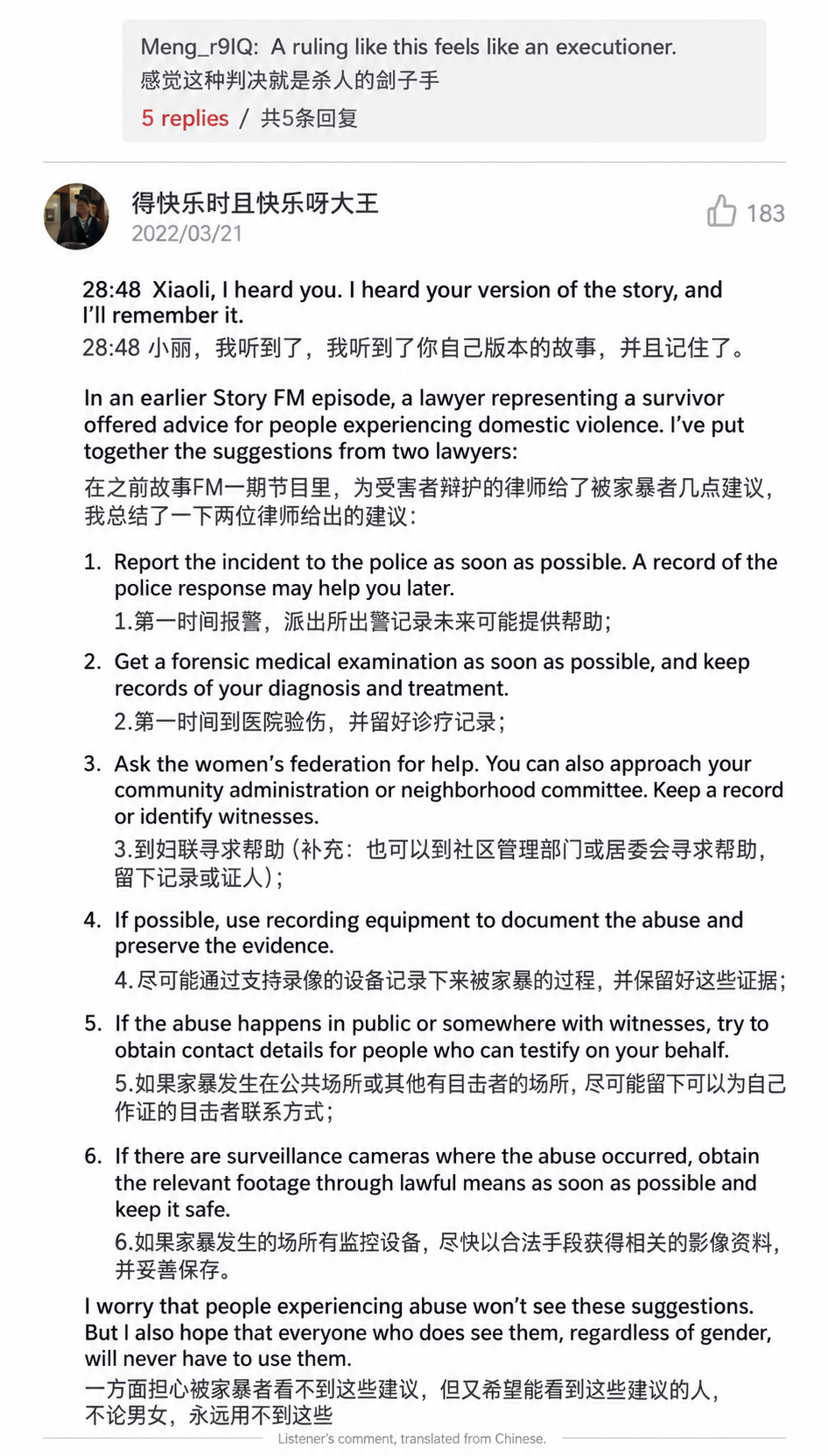
If someone wanted legal protection, they needed to think about documenting what was happening.
He gave the example of putting a camera in the home beforehand: whatever the abuser’s personality, it would record what happened.
Xiaoli also told me she wanted to speak to a therapist.
She often felt terrified when she was alone in the middle of the night.
But the domestic-violence counseling organization I was able to contact only worked with people who were currently experiencing abuse.
It still felt like nowhere near enough.
“People will look down on you if you divorce. Think of the poor children.” “He’s just immature. Maybe he’ll change once he grows up.”
I kept hearing the same reasons for staying, from one survivor to the next.
And I began to understand: in the world these women lived in, those might be the only voices they ever heard.
I wrote those reasons down and asked some friends how they would respond.
Their answers are in the episode notes.
As we finish, I’d like to ask you the same thing.
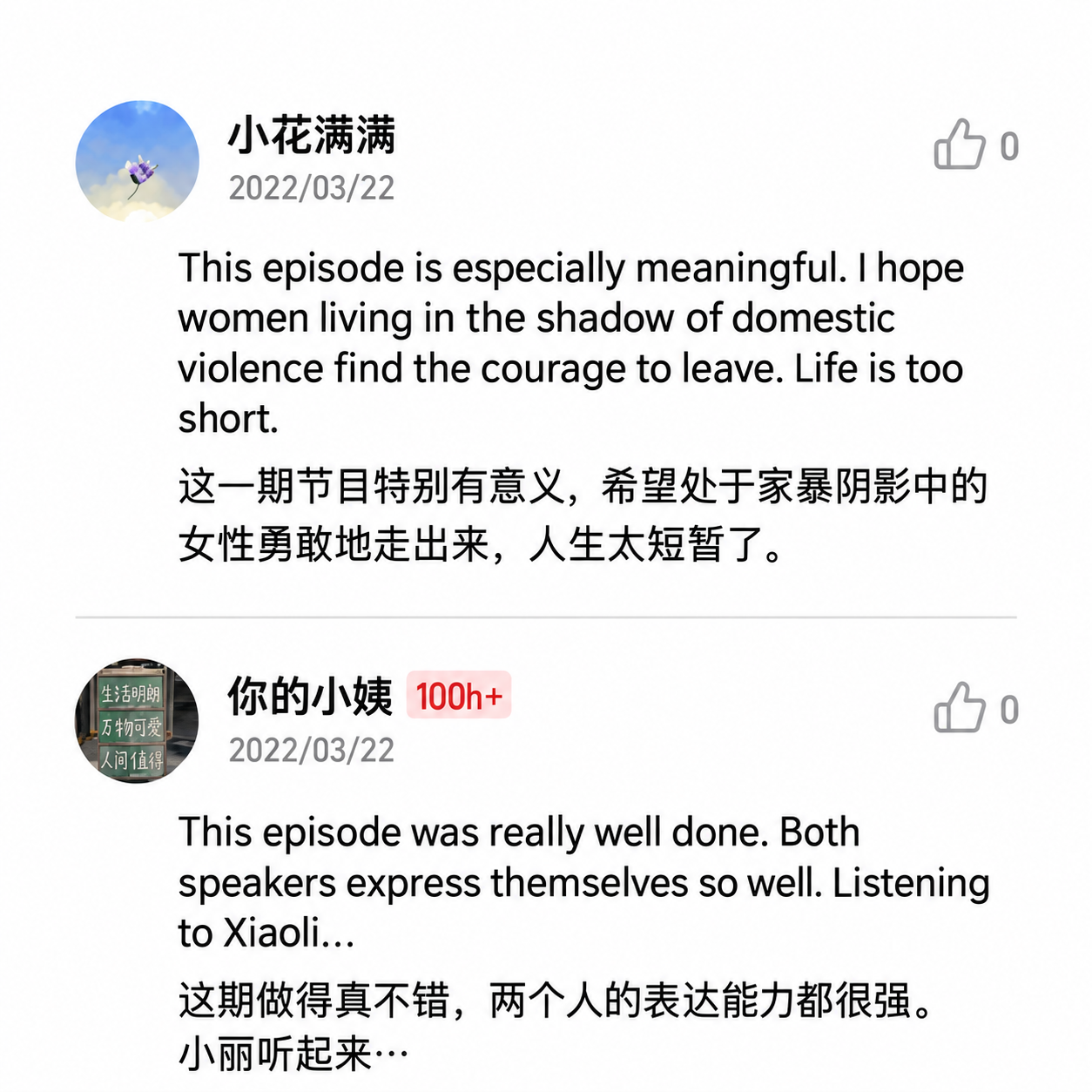
If you have something different to say to someone hearing those messages, please share it in the comments.
1. People often say: “Men are more immature than women. I need to wait for him to grow up. Maybe then he won’t act on impulse or hit me anymore.”
Chong (Written response): A lot of men take pride in saying, “Men stay boys until the day they die.” So… are you going to wait until he dies?
Zhuzi (Written response): He has already grown up.
All you can wait for is for him to grow old.
Maybe he will stop hurting you when he is too old and weak to do it—but by then, your life will have passed you by, too.
Liao (Written response): Domestic violence is never merely an impulse; it is a choice.
The “immature” boy you see is actually quite “mature”: of all the forms of violence available, he has shrewdly chosen the one with the fewest consequences.
Break the law and he could go to prison.
Hit someone else and they might hit back.
But hit you, and there are no consequences—only your tolerance and your willingness to wait.
2. People often say: “All the couples around us are like this. They fight and hit each other, and somehow they get through a whole lifetime.”
Chong (Written response): What?
Everyone around you is like this?
Then you don’t just need a divorce.
You need to get away from people who treat domestic violence as harmless squabbling.
Zhuzi (Written response): Other people’s choices aren’t necessarily right.
Sometimes, making the right choice—for your children or for yourself—means being brave enough to take the first step.
Liao (Written response): So often, your survival instinct tells you to run, while wishful thinking or dependence tells you that you can keep scraping by.
Unfortunately, once you accept that idea, you can miss the best chance to get out before things get worse.
3. People often say that divorce “looks bad,” and that others will look down on you.
Faith (Written response): People who think divorce “looks bad” aren’t good people to begin with.
Being looked down on by them, and getting away from them, is not a bad thing.
Chong (Written response): There is something deeply wrong with someone who is ashamed of divorce but not of domestic violence.
Liao (Written response): Let them look down on you.
There’s no time to worry about what everyone else thinks.
Hold on to what you want for yourself.
“Hell is other people”—aren’t those people also constantly struggling under someone else’s gaze?
If you know of other resources or have suggestions that could help Xiaoli, please share them, too.
I hope Xiaoli—and others living through something like this—can hear more voices and find more help.
Audience Comments